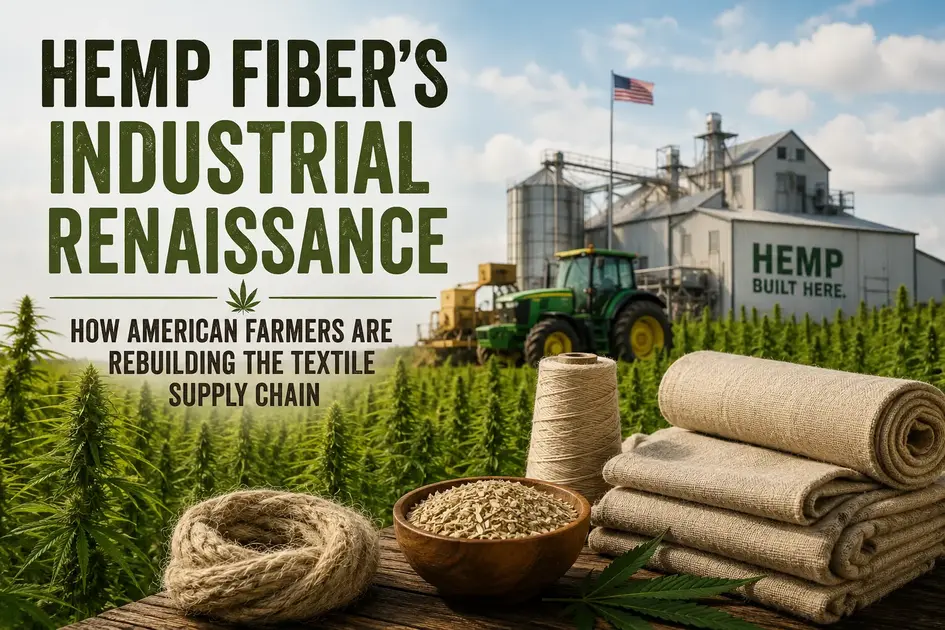
Hemp Fiber's Industrial Renaissance: How American Farmers Are Rebuilding the Textile Supply Chain
America's Oldest Crop Is Making a Comeback
Long before synthetic fibers and overseas cotton mills dominated the American textile landscape, hemp was a foundational agricultural crop. Colonial farmers grew it under legal mandate. Sails, rope, and workwear were woven from its stalks. Then, for most of the twentieth century, prohibition erased it from the American farm entirely.
That era is ending.
Thanks to the Agricultural Improvement Act of 2018 (2018 Farm Bill), hemp — defined federally as Cannabis sativa L. with a delta-9 THC concentration of no more than 0.3% on a dry weight basis — was removed from the federal controlled substances list and reclassified as an agricultural commodity. That legal change opened the door for a new generation of American farmers to grow hemp for fiber, seed, and grain, not just cannabinoids.
The industrial fiber sector, quieter than the CBD boom but far more durable, is where many of the most significant long-term investments are now flowing.
What Makes Hemp Fiber Different
Hemp produces two distinct types of fiber from the same stalk:
- Bast fiber — the long outer fibers running the length of the stalk, prized for textiles, composites, and high-strength industrial applications
- Hurd (shives) — the woody inner core of the stalk, used in hempcrete, animal bedding, biocomposites, and specialty paper
This dual-output model gives hemp an efficiency advantage over single-purpose crops. A single acre of hemp can yield roughly three to four times more fiber per acre than cotton, while requiring significantly less water and no synthetic pesticides under typical growing conditions, according to reporting by the Congressional Research Service.
For textile applications specifically, bast fiber can be processed into yarn and fabric that rivals linen in durability and is commonly reported by manufacturers and textile researchers to become softer with repeated washing — a characteristic that has driven renewed interest from apparel manufacturers looking for natural, U.S.-grown alternatives to imported synthetic blends.
The Supply Chain Gap — and Who's Filling It
The biggest challenge facing the American hemp fiber renaissance isn't demand. Consumer interest in hemp clothing, home textiles, and industrial applications has grown steadily. The challenge is infrastructure.
Domestic retting (the process of separating fiber from the stalk) and decortication (mechanical processing of bast fiber) capacity was essentially zero in 2014 when the 2018 Farm Bill's predecessor, the Agricultural Act of 2014, first authorized limited hemp pilot programs. Building that infrastructure from scratch takes capital, patience, and scale.
That investment is now happening. Processing facilities have opened across the country — among them IND HEMP in Fort Benton, Montana, processing hemp straw into bast fiber and hurd; South Bend Industrial Hemp near Great Bend, Kansas, the state's first hemp fiber processing plant; and operations in North Carolina and Pennsylvania, where the PA Hemp Industry Council has documented active decortication infrastructure investment. USDA's Agricultural Research Service has funded research into domestic hemp processing efficiency, including an active natural fiber and hemp integration research program. Regional cooperatives and supply aggregation models are emerging across fiber-growing regions, giving processors the volume signals they need to justify facility investment.
The result is a supply chain that is still early-stage but structurally sound — and positioned to accelerate as consistent federal policy provides market certainty.
Farm Bill Uncertainty and Why Fiber Hemp Is Resilient
Federal hemp policy continues to trace back to the 2018 Farm Bill, while Congress continues to debate the next long-term farm bill framework. Readers should verify the current legislative status at congress.gov before making planting or investment decisions.
This uncertainty has created volatility in the cannabinoid hemp market, where product legality can shift based on how THC and other minor cannabinoid thresholds are interpreted or revised. Fiber hemp, by contrast, operates in a cleaner regulatory space. Its value is in the stalk, not the flower. Compliance with the federal 0.3% delta-9 THC threshold (per the 2018 Farm Bill) is well within reach for fiber-optimized varieties, and the crop's end uses — textiles, composites, building materials — are entirely outside the FDA's current regulatory scrutiny of cannabinoid products.
For American farmers evaluating risk, that distinction matters.
Hemp Clothing and the Consumer Connection
The fiber-to-fabric pipeline ultimately ends at a product someone wears, sleeps on, or uses every day. Hemp clothing has shed its niche, scratchy reputation. Modern hemp fabric blends and processing techniques produce garments that are breathable, naturally resistant to bacterial growth, and durable — legitimate competitors to organic cotton and linen in the premium natural fiber market.
Supporting American-grown hemp textiles means supporting the farmers, processors, and manufacturers rebuilding that supply chain link by link.
While U.S.-grown hemp fiber supply chains are still being rebuilt, consumers can start by learning what hemp textiles feel like and why fiber processing matters. One example of a hemp fiber product is the iHemp Harvest Hemp Fiber T-Shirt (iHemp — we earn from purchases) — a way to explore the material directly and understand what the industrial hemp renaissance is working toward.
What Comes Next
The trajectory for American hemp fiber is upward, but the pace depends on policy stability, continued processing infrastructure investment, and consumer demand signals. Farmers, manufacturers, and advocates all have a role to play.
Stay informed on hemp legislation and industry developments. Connect with your state's hemp farming association. And when you have a choice between synthetic textiles and natural fiber alternatives, consider what your purchasing decision supports.
Hemp built this country once. American farmers are making the case it can help sustain it again.
For the latest on hemp legislation and regulatory updates, visit USDA's hemp page and congress.gov. Always verify current state and federal law with a qualified attorney before planting or processing hemp.